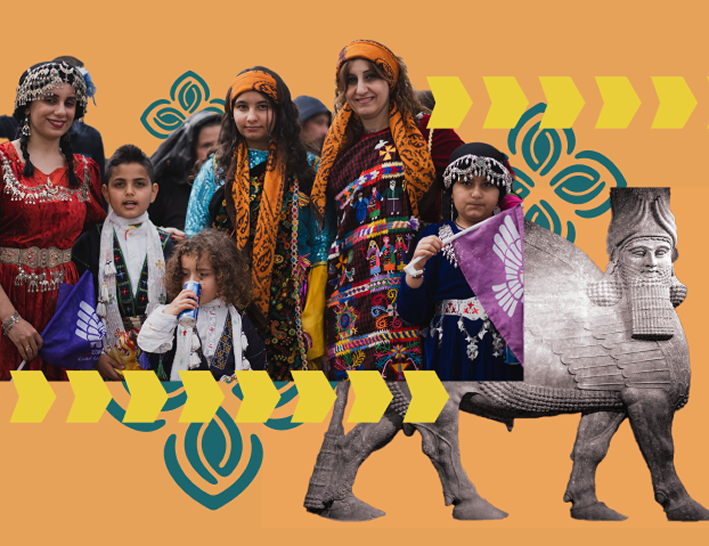
The Assyrian kingdom, being one of the base roots of Mesopotamia, encouraged urbanization, building of permanent dwellings, and cities. They also developed agriculture and improved methods of irrigation using systems of canals and aqueducts. They enhanced their language that served as a unifying force in writing, trade and business transactions. They encouraged trade, established and developed safe routes, protecting citizens and property by written law. They excelled in administration, documented their performance and royal achievements, depicting their culture in different art forms. They built libraries and archived their recorded deeds for prosperity. They accumulated wealth and knowledge; raised armies in disciplined formation of infantry, cavalry and war-chariot troops with logistics; and built a strong kingdom, a unique civilization and the first world empire.
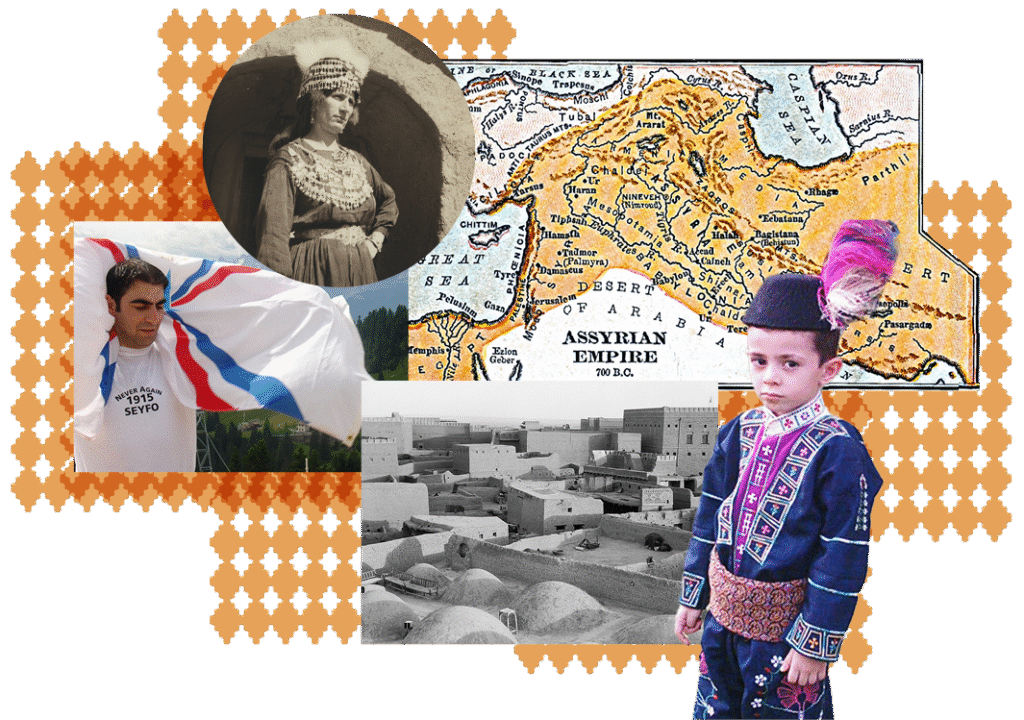
The heartland of Assyria exists in present day northern Iraq, northeastern Syria, southeastern Turkey, and northwestern Iran. The remains of the ancient capital of Assyria, Nineveh, is next to Mosul in northern Iraq.
Prior to the Assyrian Holocaust which occurred before, during and after World War I, the major Assyrian communities still inhabited the areas of Harran, Edessa, Tur Abdin, and Hakkari in southeastern Turkey, Jazira in northeastern Syria, Urmia in northwestern Iran, and Mosul in northern Iraq as they had for thousands of years.
The world’s 4 million Assyrians are currently dispersed with members of the Diaspora comprising nearly one-third of the population. Most of the Assyrians in the Diaspora live in North America, Europe and Australia with nearly 460,000 residing in the United States of America. The remaining Assyrians reside primarily in Iraq and Syria, with smaller populations in Turkey, Iran, Lebanon, and Jordan.
The Assyrians are not to be confused with Syrians even though some Syrian citizens are Assyrian. Although the name of Syria is directly derived from Assyria and Syria was an integral part of Assyrian civilization, most of the people of Syria currently maintain a separate Arab identity. Moreover, the Assyrians are not Arabs but rather have maintained a continuous and distinct ethnic identity, language, culture, and religion that predates the Arabization of the Near East. In addition, unlike the Arabs who did not enter the region until the seventh century A.D., the Assyrians are the indigenous people of Mesopotamia. Until today, the Assyrians speak a distinct language (called Aramaic [Syriac]), the actual language spoken by Jesus Christ. As a Semitic language, the Aramaic language is related to Hebrew and Arabic but predates both. In addition, whereas most Arabs are Muslim, Assyrians are essentially Christian. – Assyrian Information Management
Assyrians have become twice scattered: they live in diaspora in the Middle East and they live in diaspora outside the Middle East. Assyrian communities everywhere have experienced displacement, even those who have been forced to move from places like El Qush and Ankawa to Baghdad (in Iraq) or those pressured to abandon Sanandaj, Maragha, and prevented from resettling in Urmia (in Iran). Thus at the beginning of the twenty-first century, there are about an equal number of Assyrians living in Middle East diaspora as in diaspora outside the Middle East. In the Middle East, no coherent Assyrian community exists that has not been displaced within the twentieth century except around Mosul, the site of ancient Nineveh.1 Many Assyrians born in the first two decades of the twentieth century had, by the close of that century, moved or been displaced three, sometimes four times. – Eden Naby, The Assyrian diaspora: Cultural Survival in the Absence of State Structure