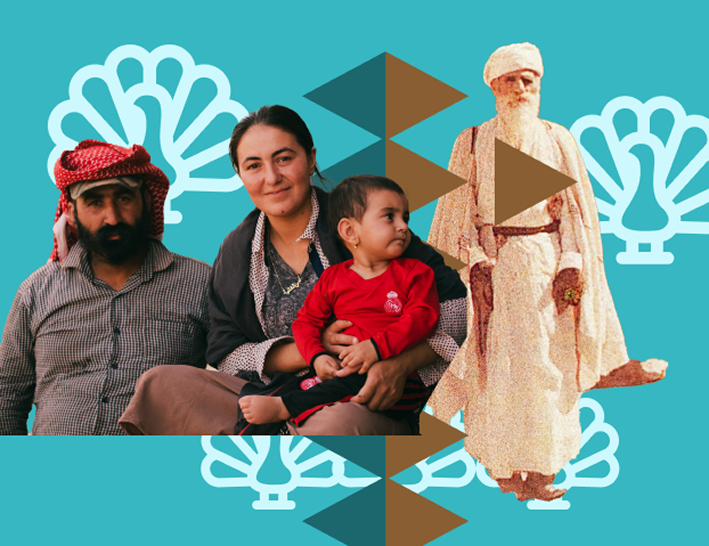
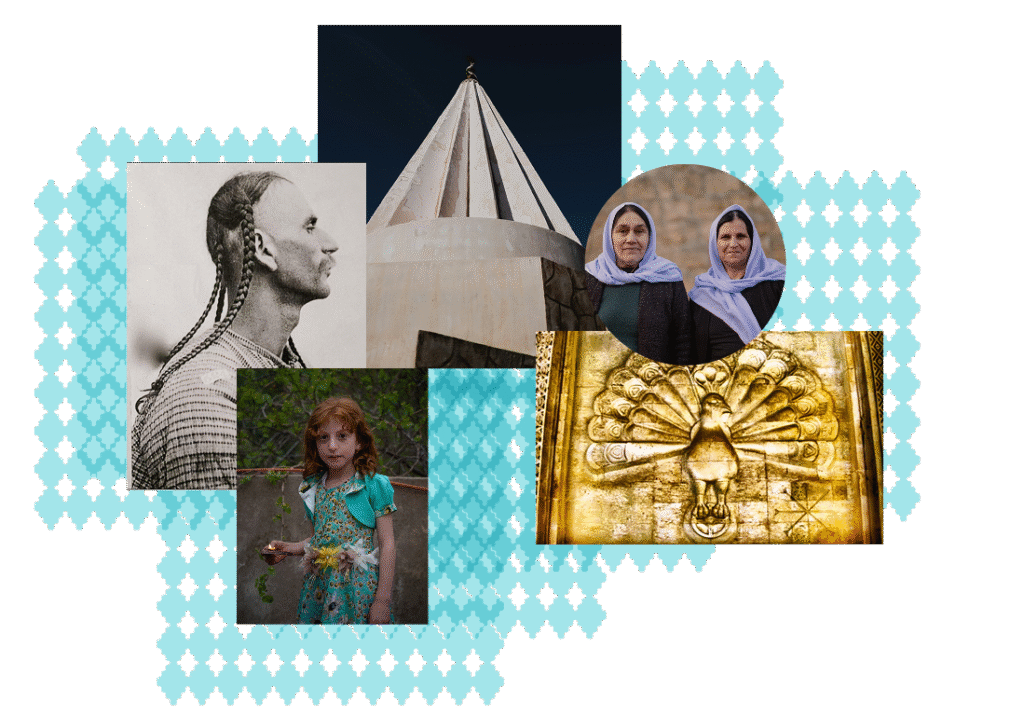
“Yazidis believe in an ancient, monotheistic religion that combines pre-Islamic, Islamic, and Abrahamic elements. Their veneration of Tawusi Melek, the Peacock Angel, who is one of God’s Seven Angels and is in charge of worldly affairs, is a core aspect of their religion. Unfortunately, since the Middle Ages, many Muslims have misinterpreted the figure of the Peacock Angel as Iblis, a version of Satan who appears in the Qur’an. Because of this, Yazidis have endured centuries of religious persecution at the hands of Muslim groups due to false accusations of “devil worship,” with the events of 2014 being the 74th genocide in a long and painful chronology.
After a series of rapid conquests of major cities in Iraq during the summer of 2014, IS invaded the Yazidi homeland of Sinjar and Sheikhan in northern Iraq on August 3rd, 2014. The jihadist group rounded up Yazidi men and ordered them to convert to Islam. Those who refused were executed in mass graves, and sometimes even along with men who converted. Yazidi women and girls were separated from their families and sold into sexual slavery. Girls as young as nine were sold in slave markets in Iraq and Syria and taken into captivity by men from around the world. Yazidi boys were also separated from their families and were trained to become jihadists. They were taught how to use various types of weaponry and were indoctrinated into IS’ ideology. Overall, at least 10,000 people were killed or captured during the genocide, with approximately 3,000 Yazidi women and children remaining in IS captivity as of 2021.” – Yazidi Genocide Archive
“According to Eszter Spat in The Yezidis, the name is derived from ezXwede dam, meaning “I was created by God.” Some Yezidis maintain that it translates as “Followers of the true path.” The term Yezidi or Yazidi is also very close to the Persion/Zoroastrian word Yazdan, meaning “God“, and Yazata, meaning “divine” or “angelic being“.
For this reason scholars have theorized a Persian origin for the Yezidis. Other scholars have associated the name Yazidi with Yazid bin Muawiyah, a Muslim Caliph ofthe early Umayyad Dynasty. According to the current Yezidi belief, however, the Caliph Yazid was a Muslim ruler. The ignorance on who Yazid was, was also the reason for much of the Yezidis’ suffering throughout Middle East. Although there are similarity in the spelling of the word Yazid and Yezidis one has nothing to do with the other. The relation of one to the other ends at the few letters that both words have in common. Yazid was the son of Muawiya, a Muslim person. He was a caliph from the year 680- 683 and was the cause of the tragedy in Karbala. He was the cause of Imam Husein’s beheading and many Muslims point at Yezidis (the religious minority group in Iraq) as the group to blame. Their evidence? Similarity in the writing and pronunciation of the name Yazid and Yezidis.” – Yezidis International