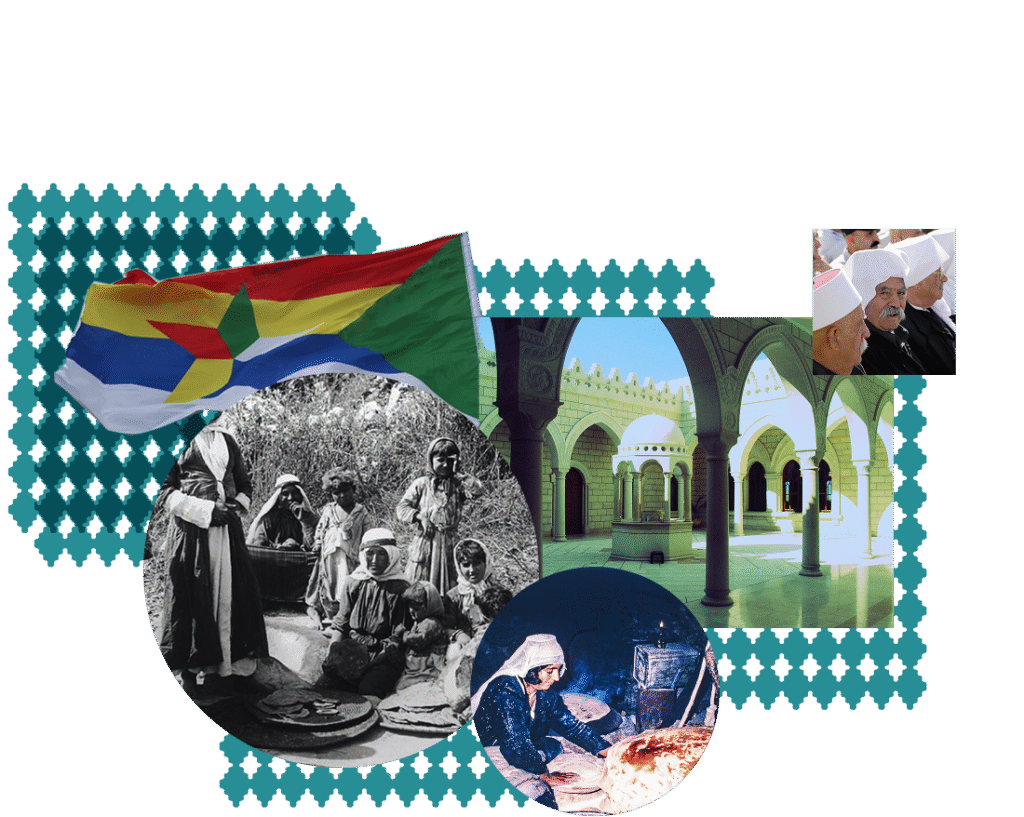
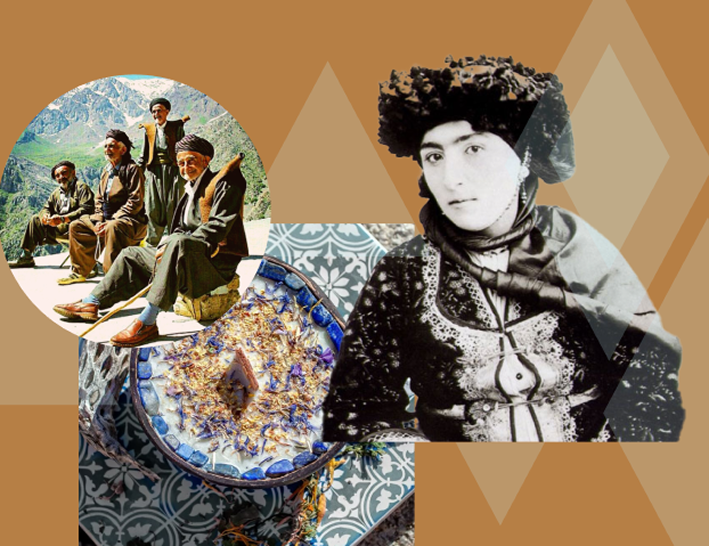
“The Druze faith dates back as early as the 11th century. The faith was greatly influenced by a diversity of religious sources including the Quran and Christian and Jewish Scripture, as well as elements of Greek philosophy, Eastern mysticism, and other ancient doctrines. The Druze progressive interpretation – including abolition of slavery, equal treatment of men and women, and separation of church and state – was considered unorthodox, especially so early on.
Like all religious sects, while seeking knowledge of God, one’s self, and the world, the Druze believe that faith without knowledge is stagnation, and knowledge without faith is emptiness.
The Druze are followers of the Tawheed faith that centers on the belief in the oneness of God.
According to most sources, lacking an exact census, the Druze number around one to two and a half million worldwide. The largest concentration is in Syria, followed by Lebanon, Israel, Palestine, and Jordan. The rest are scattered throughout the world, in the U.S., Europe, Australia, South America, Canada, and other countries.
For most Druze, their identity is defined more by family values and traditions than by the pillars and rituals of their faith. In actuality, the religion is non-ritualistic; there are no practical commandments such as prayer, fasting, pilgrimage, or day of rest required from its members. There are also no religious teaching institutions.
Individuals enjoy freedom of choice in the practice of religion, which is considered a private experience rather than a public right – a sort of ‘secret’ between man and God that should not be divulged to others.
This freedom of choice is respected as long as the main precepts of the faith are adhered to: i.e., truthfulness (Sudk el-lisan); safeguarding of brethren (Hifz el ikhwan); belief in the unity of God in every age and stage; acceptance of His divine acts – whatever they may be; and submission to His will, in private and in public.
The Druze way of life is erected atop honorable values and precepts, crowned by truthfulness and the safeguarding of brethren. The Druze are focused on egalitarianism, self-discipline, oneness of God, supremacy of the mind, and community-bound reincarnation. Deeply entrenched are the notions that the community is literally composed of brothers and sisters and that Druzeness is its own distinct ethnicity.” – American Druze Foundation
A distinct and marginalized region
“As a Druze-majority, marginal province, Swaida was chronically underdeveloped. Its autonomy grew after 2014, when locals refused to be conscripted to fight their own people. In 2018, Swaida suffered a devastating Islamic State of Iraq and al-Sham (ISIS) attack, which resulted in the community’s need for protection and armament, leading to the formation of many armed groups. In 2023, Swaida further distanced itself from Damascus, when Druze leader Sheikh al-Hajari endorsed a civic uprising calling for regime change from Assad, leading to his rise as a political figure addressed by US officials, overshadowing the other two Druze religious leaders, Sheikhs Jarbouh and Hennawi.
These dynamics fostered a distinct socio-political status for Swaida—outside of full Damascus control—with local armed groups, mainly directed at deterring extremists, and a political structure strongly influenced by al-Hajari in the absence of an alternative political process. But when Assad fell abruptly in late 2024 and Hayat Tahrir al-Sham (HTS), once labeled extremist over its ties to al-Qaeda, took control, the opposition and transitional authorities failed to offer a path to re-merge these two political structures. A rushed attempt at state-building led instead to exclusion, mistrust, and instability—especially for minorities like the Druze, who bore arms mainly to deter extreme Islamist groups like HTS.” – Majd AlGhatrif, A distinct and marginalized region