Jewish
Community
Explore books about the Jewish community:
-
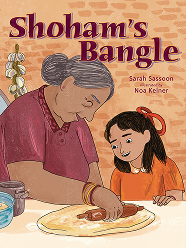
by Sarah Sassoon (Author), Noa Kelner (Illustrator)
Shoham wears a golden bangle on her wrist, just like her Nana Aziza. Their bangles jingle when they cook, and glitter in the sun. When Shoham and her family must leave Iraq, they are allowed to take only one suitcase each. They may take no jewelry. Shoham has the important job of carrying Nana’s homemade pita bread, which Nana says they will eat when they get to Israel. But when they finally arrive and it is time to eat, Shoham finds a surprise in the pita bread!
-
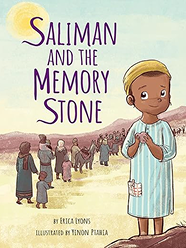
by Erica Lyons (Author), Yinon Ptahia (Illustrator)
When young Saliman’s family left Yemen in 1881 to move to Jerusalem there were so many things they could not take along. Promising to remember it all, even the names of each their goats and the color of their fur, he clutched his memory stone, a piece of his house that he kept in his pocket, as a way to keep Yemen in his heart. Saliman and the Memory Stone is a fictionalization of the real emigration of hundreds of Yemeni Jews to Jerusalem
-
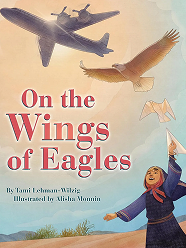
by Tami Lehman-Wilzig (Author), Alisha Monnin (Illustrator)
Based on real events, this picture book for ages 5-8 dramatizes the story of young Haila, a Yemenite girl, who with her family was airlifted to safety by Alaska Airlines pilot Warren Metzger during Operation Magic Carpet, an international effort that rescued nearly 50,000 Jews from the dangers of Yemen in 1949 and 1950.
-
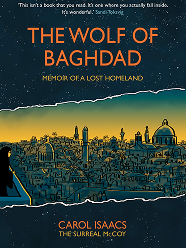
by Carol Isaacs
In the 1940s a third of Baghdad’s population was Jewish. Within a decade nearly all 150,000 had been expelled, killed or had escaped. This graphic memoir of a lost homeland is a wordless narrative by an author homesick for a home she has never visited. Transported by the power of music to her ancestral home in the old Jewish quarter of Baghdad, the author encounters its ghost-like inhabitants who are revealed as long-gone family members. As she explores the city, journeying through their memories and her imagination, she at first sees successful integration, and cultural and social cohesion. Then the mood turns darker with the fading of this ancient community’s fortunes.
-
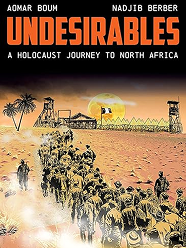
by Aomar Boum (Author) and Nadjib Berber (Illustrator)
In this historical graphic novel, historian Aomar Boum and illustrator Nadjib Berber follow the journey of Hans Frank, a Jewish journalist who flees Berlin as the Nazis rise to power. Guided by a transnational anti-fascist network, he escapes to French Algeria—only to be labeled an “undesirable” under the Vichy regime. Attempting to reach Morocco, Hans is detained and sent first to Le Vernet and later to forced labor camps across Morocco and Algeria. Over the next eighteen months, he struggles to survive while hearing the stories of others whose lives have been shattered by war and displacement.
-
by S. D. Goitein
This six-volume “portrait of a Mediterranean personality” is a composite portrait of the individuals who wrote the personal letters, contracts, and all other manuscript fragments that found their way into the Cairo Geniza. Most of the fragments from the Geniza, a storeroom for discarded writings that could not be thrown away because they might contain the name of God, had been removed to Cambridge University Library and other libraries around the world. Professor Goitein devoted the last thirty years of his long and productive life to their study, deciphering the language of the documents and organizing what he called a “marvelous treasure trove of manuscripts” into a coherent, fascinating picture of the society that created them.
-
by Sara Koplik
In “A Political and Economic History of the Jews of Afghanistan,” Sara Koplik describes the conditions of the community from its growth in the 1840s to their emigration to Israel in the 1950s.
-
by Alanna E. Cooper
Part ethnography, part history, and part memoir, this volume chronicles the complex past and dynamic present of an ancient Mizrahi community. While intimately tied to the Central Asian landscape, the Jews of Bukhara have also maintained deep connections to the wider Jewish world. As the community began to disperse after the fall of the Soviet Union, Alanna E. Cooper traveled to Uzbekistan to document Jewish life before it disappeared.
-
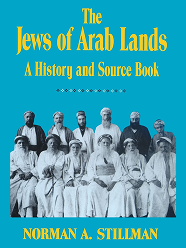
by Norman A. Stillman
Norman Stillman has produced a comprehensive and articulate history of the turbulent and complex relationships in the Middle East that brilliantly captures the people and the history.
-
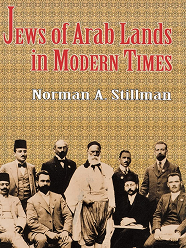
by Norman A. Stillman
At a time when hostilities and violence in the Middle East and Persian Gulf continually threaten the world with war, anyone seeking to understand the current situation must become familiar with the interrelationships of the Jewish and Arab cultures. This book focuses on the forces, events, and personalities that over the past 150 years have shaped the Jewish communities of the Arab world, changing the relations between Jews and Arabs more radically than anything since the rise of Islam nearly 1400 years ago.
-
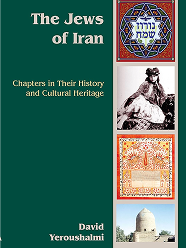
by David Yeroushalmi
“The present work provides a historical overview of Jews living on Iranian soil and offers studies dealing with specific facets of their centuries old cultural heritage. Divided into two separate but closely related parts, the book consists of eight chapters. Part one, History and Community, includes four chapters that throw light on the history of Iran’s Jewish minority from the 8th-century BCE through the 20th century. The second part, Cultural Heritage, investigates some specific features of Jewish culture and tradition in Iran. These include Judeo-Persian literature and poetry, a typical Judeo-Persian treatment of a Jewish canonical text, and the character of Jewish education in pre-modern Iran”–Provided by publisher.
-
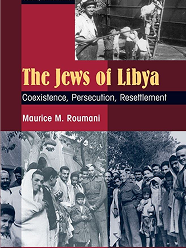
by Maurice M. Roumani
This book investigates the transformative period in the history of the Jews of Libya (1938-52), a period crucial to understanding Libyan Jewry’s evolution into a community playing significant roles in Israel, Italy and in relation with Qaddhafi’s Libya. Against a background of a reform conscious Ottoman administration (1835-1911) and subsequent stirrings of modernisation under Italian colonial influence (1911-43), the Jews of Libya began to experience rapid change following the application of fascist racial laws of 1938, the onset of war-related calamities and violent expressions of Libyan pan-Arabism, culminating in mass migration to Israel in the period 1949-52.
-
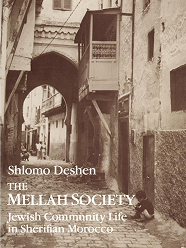
by Shlomo Deshen
The Mellah Society is a compact yet detailed and fascinating account of Jewish life in precolonial Morocco, based on the voluminous but rarely studied writings of eighteenth- and nineteenth-century Judeo-Moroccan sages.
-
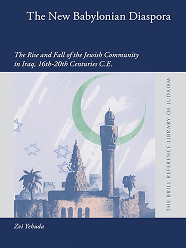
by Zvi Yehuda
The New Babylonian Diaspora: Rise and Fall of Jewish Community in Iraq, 16th20th Centuries C.E. provides a historical survey of the Iraqi Jewish community’s evolution from the apex of its golden age to its disappearance, emergence, rapid growth and annihilation.